Lung Mechanics

Definitions

  • Where:
    • is the minute ventilation
    • is the tidal volume
  • Where:
    • is the alveolar ventilation
    • is the physiologic dead space
  • Where
    • is airflow
    • is pressure gradient
    • is airway resistance
  • Where
    • Resistive pressure is the pressure required to push airflow through the airways
    • Elastic pressure which is the pressure required to inflate lungs and chest wall

Monitoring

  • An increasing in the abscence of an increasing suggests airway resistance is increasing (e.g. bronchospasm, excessive scretions, mucous plug, foreign body aspiration, extrinsic airway compression)
  • An increasing suggests compliance is decreasing (e.g. pulmonary oedema, pleural effusion, pneumothorax, right mainstem bronchus intubation, ascites or other abdominal distension)
Likely problem
IncreasedNormalIncreased airway resistance
IncreasedIncreasedDecreased lung compliance

Gas Exchange

Normal Gas Exchange

  • Alveolar ventilation equation
  • Where
    • is the partial pressure of in arterial blood
    • is the rate of systemic production
    • is the pressure of inspired air
    • is the alveolar ventilation
  • Importantly
MechanismExamples
VQ mismatchPneumonia, PE, pulmonary oedema, COPD
ShuntCongenital heart disease, pulmonary AVM
Thickening of the alveolar-capillary membraneInterstitial lung disease, pulmonary oedema
Destruction of the alveolar capillary membraneEmphysema

Monitoring

  • ABG Interpretation
  • Pulse oximetry
  • Capnography
    • Note that
      • However, the gap can be
        • Increased to >5 mmHg in low cardiac output, COPD, PE, advanced age
        • Decreased to <2 mmHg in high cardiac output states (e.g. septic shock)

Non-Invasive Ventilation

CPAP

  • Maintains alveolar recruitment and improves pulmonary shunting
  • Improves predominantly oxygenation and therefore indicated in type 1 respiratory failure

BiPAP

  • S/T mode refers to spontaneous and timed mode and therefore has a backup rate
  • S mode refers to spontaneous (only)

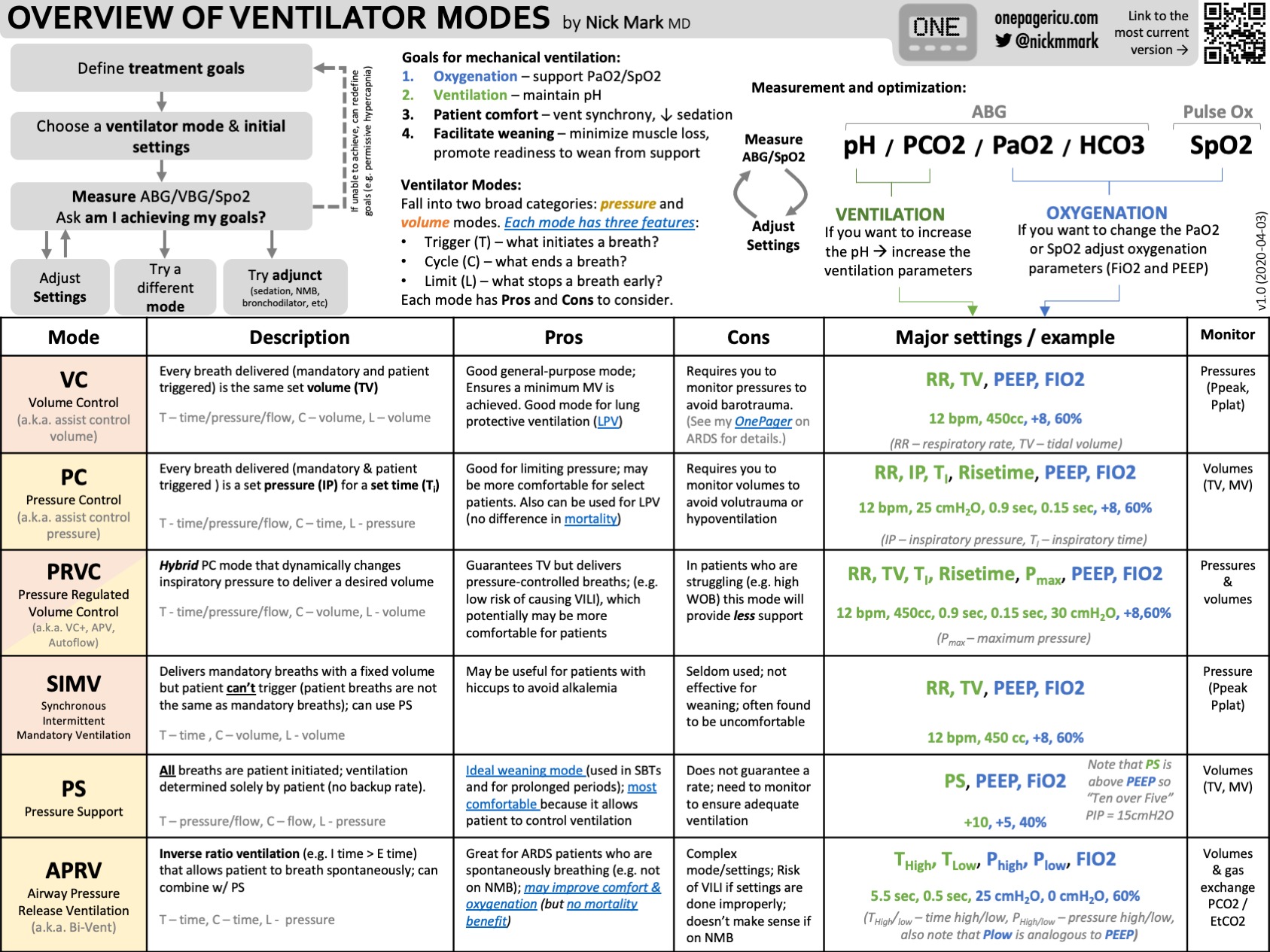
Ventilator Modes

  • Modes can be partially defined by:
    • Trigger variable: when to initiate a machine-driven breath. Common options include: time triggered, pressure triggered, flow triggered
    • Control variable: defines what aspect of inspiration is the primary variable controlled by the ventilator during inspiration. Common options include: pressure controlled, flow controlled (also known as volume controlled)
    • Cycling variable: defines what signals the ventilator to terminate inspiration. Common options include: volume cycled, flow cycled, time cycled. Uncommon options include: pressure cycled

Assist Control (AC)

  • Mix of mandatory and assisted breaths with all breaths, once triggered, are treated the same and have a consistent tidal volume
  • Trigger: time, pressure or flow
  • Control: flow (volume)
  • Cycling: time
Figure 1. Assist control. Note that the 1st, 3rd and 4th breaths are patient triggered with the second breath being time triggered.
  • Advantages
    • Guarantees a minimum minute ventilation
    • Low work of breathing
  • Disadvantages
    • Can lead to respiratory alkalosis, auto-PEEP and hypotension in hyperventilating patients as every breath leads to a fully supported breath
  • Indications
    • Critically ill patients requiring full ventilatory support and in whom fluctuations in is undesirable

Synchronised Intermittent Mandatory Ventilation (SIMV)

  • Mix of mandatory breaths (some of which are synchronised with spontaneous breaths), and assisted breaths
  • Mandatory (non-synchronised breaths):
    • Trigger: time
    • Control: flow (volume)
    • Cycling: time
  • Synchronised breaths:
    • Trigger: pressure or flow
    • Control: flow (volume)
    • Cycling: time
  • Non-synchronised breaths
    • Trigger: pressure or flow
    • Control: pressure
    • Cycling: flow
Figure 2. SIMV (with pressure support). Note that the first and fourth breaths are synchronised pressure triggerred fully supported breath with tidal volume set for ~600 mL. The second, third and fifth breaths are spontaneous non-synchronised breaths assisted with pressure support with 10 cm of water.
  • Advantage
    • Guarantees a minimum minute ventilation
    • Lower mean airway pressure when compared with AC
    • Can provide a wide range of respiratory support
  • Disadvantages
    • Increased work of breathing for patient
    • ? Lower cardiac output in patients with LV dysfunction
  • Indications
    • Critically ill patients who are hyperventilating or otherwise prown to auto-PEEP or high airway resistance

NOTE

The main difference between SIMV and AC is that spontaneous breaths in excess of the set respiratory rate:

  • In AC receive full support
  • In SIMV receive partial support Therefore in a patient with no spontaneous breaths AC = SIMV

Pressure Control Ventilation (PCV)

  • Mandatory breaths only. The patient is unable to trigger the ventilator
  • Trigger: time
  • Control: pressure
  • Cycling: time
Figure 3. Pressure Control Ventilation. Inspiratory pressure is set at 25cm of water. Flow starts high with each breath and rapidly declines (known as a decelerating flow contour).
  • Advantages:
    • Prevents excessive airway pressures
    • Avoids regional alveolar overdistention
    • May lead to earlier liberation from mechanical ventilation
  • Disadvantages
    • Very uncomfortable and requires deep sedation ± paralysis
    • Unable to guarantee a minimum minute ventilation
  • Indications
    • Patients who are at a particularly high risk of barotrauma

Pressure Support Ventilation (PSV)

  • There are no mandatory breaths; every breath must be triggered by the patient
  • Trigger: Pressure or flow
  • Control: Pressure
  • Cycling: Flow
Figure 4. Pressure support ventilation. The pressure support is set at ~15cm of water. Inspiration is terminated by the removal of pressure support once the flow drops to 25% of its maximum
  • Advantages:
    • Probably the most comfortable mode for the awake, conscious patient
  • Disadvantages:
    • Patient must trigger each breath
    • A minimum minute ventilation cannot be guaranteed
    • Associated with poorer quality sleep
    • Generally incapable of providing full ventilatory support
  • Indications
    • Conscious patient
    • As a stepping stone immediately prior to extubation

Dual Control modes

  • Use instantaneous feedback to control aspects of lung volume and airway pressure simultaneously
  • Examples include
    • Pressure-regulated volume control
    • Volume support
    • Volume assured pressure support

Ventilator Options

  • Mode
  • Fraction of inspired oxygen
  • Tidal volume ()
  • Respiratory rate (RR)
  • Positive End-Expiratory Pressure (PEEP)
  • Pressure Support (PS)
  • Flow shape/contour
  • Inspiratory:Expiratory (I:E) ratio

Fraction of Inspired Oxygen

  • should be titrated to the lowest value which still maintains adequate oxygenation
  • In common practice, it is set at 100% after the patient is first intubated, and then titrated downward over one to several hours as indicated by pulse oximetry and/or serial ABGs
  • leads to oxygen toxicity in the lungs, therfore if adequate oxygenation requires , additional strategies are required:
    • ↑ PEEP
    • Recruitment manoeuvres
    • Trial of a different mode

Tidal Volume

  • Most applicable to volume cycled modes (AC, SIMV)
  • Initial values should be weight based with:
    • Healthy lungs 10mL/kg of ideal body weight (as in neurological catastrophy, drug overdose)
    • COPD 8mL/kg
    • ARDS 6mL/kg
  • Higher leads to ↓ , ↑ pH and ↑ and vice versa

Respiratory Rate

  • Typical respiratory rate is 10-20 breaths/min in order to provide 7-10 L/min of minute ventilation
  • Higher RR leads to ↓ , ↑ pH and higher risk of auto-PEEP and vice versa

Positive End-Expiratory Pressure

  • Continuous positive pressure present throughout all of ventilation
  • Physiologic effects:
    • ↑ oxygentation
      • ↑ alveolar recruitment
      • ↑ alveolar surface area
    • ↑ cardiac output in CHF patients but can ↓ BP in non CHF patients
      • ↓ preload
      • ↓ LV afterload
    • ↑ RV afterload → ↑ R-L shunts if present
Figure 5. Relationship between oxygen delivery and PEEP. There exists a sweet spot where an optimal PEEP delivers optimised oxygen delivery
  • In clinical practice: PEEP is set to the lowest value that allows F to be ≤ 60% with a minimum value of 5 cm of

Pressure Support

  • Amount of additional positive pressure beyond PEEP that is provided during inspiration. Important in pressure support ventilation, BiPAP and almost always used in SIMV
  • Simple estimate of optimal PS is:
  • However in practice, PS is typically set to twice PEEP

Flow Shape/Contour

  • Describes the pattern of airflow during inspiration and is set in volume-targeted ventilator modes
    • Always decelerating shape in pressure-targeted modes as a consequence of lung mechanics
  • Options include:
Figure 6. Decelerating flow contour
Figure 7. Constant flow contour
  • Decelerating flow contour results in:
  • Constant flow contour results in:
    • Less auto-PEEP

Inspiratory : Expiratory Ratio

  • Ratio between the amount of time spent in inspiration and the amount of time spent in expiration
  • In AC and SIMV it is usually set indirectly via and flow rate/pattern
  • In PCV it is usually set directly
  • In PSV it is generally outside of clinician control
  • A higher ratio (higher inspiratory time) results in ↑ and higher risk of auto-PEEP and vice versa

Typical Initial Ventilator Settings

OptionTypical Settings
ModeIntrinsic hyperventilation → SIMV
No intrinsic hyperventilation → AC or SIMV
FiO₂Start at 100%
Taper as able to 35–60% to keep PaO₂ >60–80 mmHg
Tidal Volume (V_T)~10 cc/kg for normal patients
~8 cc/kg for COPD
~6 cc/kg for ARDS
(Use ideal body weight)
Adjust as needed based on pH; consider lowering V_T if P_plateau > 30 cmH₂O
Rate10–20 breaths/min to achieve MV of 7–10 L/min; adjust based on pH
PEEPStart at 5 cmH₂O
Titrate up if PaO₂ <60 on >60% FiO₂
May start with no PEEP in pure hypoventilation
Pressure Support (n/a for AC)5–20 cmH₂O
Optimal PS ≈ P_plateau − PEEP
(Minimum 5 cmH₂O PS always to overcome ETT resistance)

Lung Protective Ventilation

Ventilator Associated Lung Injury

  • Most frequently complicates ALI and ARDS
  • Types include
    • Barotrauma: caused by excessively airway pressures
    • Volutrauma: caused by excessive
    • Biotrauma
    • Cyclic atelactasis
  • Oxygen toxicity
    • For patient on bleomycin, oxygen toxicity can occur at lower

Barotrauma

  • Manifestations
    • Pneumothorax
    • Pneumomediastinum
    • Subcutaneous emphysema
    • Systemic gas embolism
    • Cystic barotrauma
  • Risk factors
    • High
    • High minute ventilation
    • Non-homogenous parenchymal disease (e.g. ARDS)
    • Necrotising lung pathology
    • Secretion retention

Biotrauma

  • Release of proinflammatory cytokines in response to supranormal intraalveolar pressures; occurs in the absence of physical damage to lung architecture (as in barotrauma)
  • Most clinically relevant manifestation is that of pulmonary and interstitial oedema

Protective

  • Principle feature is low tidal volumes
  • Permissive hypercapnoea: is allowed to climb , with a resulting drop in arterial pH
    • Contraindicated in increased ICP, haemodynamic instability, right heart failure, severe metabolic acidosis
  • Open lung ventilation
    • Strategy that combines: low tidal volumes and high PEEP

Protocol for ARDS

  1. Choose ventilation mode (typically AC or SIMV)
  2. Start with of 6mL/kg of IBW
  3. Start with PEEP at ≥ 8cm
  4. Set the I:E ratio of 1:2
  5. Measure and record every 4 hours and after any changes in or PEEP
    • If >30 cm , ↓ in 1mL/kg increments until ≤30 cm or to minimum of 4mL/kg IBW
    • If < 6mL/kg IBW and <25 cm , ↑ by 1mL/kg IBW increments to a max of 6mL/kg
  6. Adjust the RR and according to pH goals:
    • If pH <7.30, consider ↑ RR to as high as 35 breaths/min while monitoring for development of auto-PEEP
    • If pH <7.15 and RR ≥ 35 breaths/min, consider ↑ and suspending limit
  7. Adjust I:E ratio to avoid auto-PEEP and dysynchrony
  8. Adjust PEEP to maximise alveolar recruitment while avoiding over-distention:
    • ↑ or ↓ PEEP in increments of 2-3 cm of
    • Select PEEP that gives the best compliance
  9. Adjust the to achieve of 88-95% and/or of 55-80 mmHg

Physiological Consequences

Affects on Gas Exchange

  • At low and medium levels of PEEP, it leads to improved alveolar recruitment which leads to larger surface area for gas diffusing
  • At high levels of PEEP, alveolar dead space increases dramatically
    • Occurs because PEEP has a greater effect on normal compliant alveoli than it does on stiff/fluid filled alveoli. This means that at high PEEP, healthy alveoli become overdistended, thereby increasing resistance to blood flow to these units, shunting blood towards poorly ventilated, abnormal alveoli. This increases physiologic dead space, worsening V/Q mismatch
  • High PEEP can also increase pulmonary vascular resistance which can worsen intracardiac R-L shunts

Affects on Haemodynamics

  • Preload
    • PEEP can decrease preload because:
      • ↑ CVP → ↓ venous return to RA ↑ RV afterload → ↓ blood exiting RV
      • ↑ RV afterload → leftward displacement of the IV septum → impairs LV diastolic filling
  • Left ventricular afterload
    • PEEP decreases which leads to decreased afterload (as per law of laplace before)
  • The effect on cardiac output and blood pressure is highly dependent on the patient’s volume status
    • If the patient is hypovolaemic or euvolaemic, the decreased preload will significantly decreased cardiac output and blood pressure
    • If the patient is hypervolaemic, the cardiac output will increase and the blood pressure may increase or remain unchanged

Affects on Positive Pressure on Monitoring

  • High levels of PEEP impair the usual means of assessing cardiac preload (i.e. CVP and PCWP)
  • Alternative strategies include:
    • Calculating
      • With normal lung compliance:
      • With abnormal lung compliance:
    • Right ventricular end diastolic volume
    • Intrathoracic blood volume
    • Respiratory variation in aortic blood velocity

Affects on Cerebral Perfusion

  • Can in some circumstances decrease cerebral perfusion although this is variable

Pathologic Consequences

  • Complications from Intubation:
    • Dental trauma
    • Aspiration
    • Laryngeal damage
    • Bronchospasm
    • Oesophageal intubation
    • Right main bronchus intubation

Auto-PEEP (aka Intrinsic PEEP)

  • Auto-PEEP is positive airway pressure that occurs at the end of expiration due to incomplete exhalation
  • Consequences include:
    • ↑ Risk of barotrauma
    • ↓ Venous return → ↓ cardiac output → hypotension
    • Worsened V/Q mismatch
    • Patient-ventilator dyssynchrony
    • ↑ in patient’s work of breathing
  • Mechanisms by which auto-PEEP develop:
    • High minute ventilation (e.g. high and/or high respiratory rate)
    • Expiratory flow limitation (e.g. high airway resistance in COPD)
    • Expiratory resistance (e.g. kinked ET tube, patient-ventilator dyssynchrony)
Figure 9. Auto-PEEP absent
Figure 10. Auto-PEEP present
- Examine for audible air flow extending to the end of expiration on auscultation $$ \text{Auto-PEEP}=\substack{\text{End-expiratory}\\\text{Alveolar Pressure}}-\substack{\text{Applied}\\\text{PEEP}} $$ - It can be quantified using an end-expiratory breath hold where the rise in pressure above the applied PEEP represents the auto-PEEP - Treatment strategies: - For high minute ventilation: ↓ $V_{\text{T}}$, ↓ respiratory rate or ↓ I:E ratio (these strategies allow for some permissive hypercapnoea) - Expiratory flow limitation: bronchodilators, secretion management, ↑ Applied PEEP - Expiration resistance: upsize ET tube, ↑ sedation, paralytics ## Patient-Ventilator Dyssynchrony - Dyssynchrony is a state in which the respiratory cycle of the patient does not always match that of the ventilator - General signs of possible dyssynchrony include increased heart rate, increased respiratory rate, decreased $S_\text{p}\ce{O2}$, increased expiratory muscle activity, coughing, agitation and visible inspiratory effort without triggering the ventilator
Phase of RespirationTypes and Subtypes of Dyssynchrony
InspirationTrigger Dyssynchrony
- Trigger Delay
- Missed Trigger
- Auto-Triggering
- Double-Triggering
InspirationFlow Dyssynchrony
ExpirationCycling Dyssynchrony (a.k.a. Termination Dyssynchrony)
- Premature Termination
- Delayed Termination
  • Trigger delay: an extra delay occurs between when the patient attempts to initiate a breath and when the ventilator begins to deliver it
    • Fixes include: ↓ trigger pressure, ↓ sedation, correction electrolyte abnormalities, bronchodilators or ↑ ET tube size, or correcting auto-PEEP
  • Missed trigger: Insufficient respiratory effort fails to reach threshold for triggering ventilator
    • Fixes include: ↓ trigger pressure, ↓ sedation, correction electrolyte abnormalities, bronchodilators or ↑ ET tube size, or correcting auto-PEEP
  • Auto-triggering: Occurs when the ventilator interprets signals other than the patient’s attempt to initiate a breath as signal deliver an inspiration
    • Fixes include: ↓ triggering sensitivity or addressing noise
  • Flow dyssynchrony: occurs when the flow rate is set too low for the patient’s respiratory demand (seen in volume control modes)
    • Fixes include: ↑ inspiratory flow rate, changing inspiratory flow pattern or changing the ventilator mode
Figure 11. Flow dyssynchrony. Note the concave or scalloped appearance of the inspiration waveform
  • Cycling dyssynchrony
    • Delayed termination
      • Here the ventilator inspiratory time exceeds that of the patient (i.e. patient tries to initiate expiration while the ventilator is still delivering inspiration)
      • It can be identified by a sharp spike in airway pressure at the end of inspiration
      • Fixes include: changing cycling threshold to cycle earlier, changing ventilator mode to time cycled in order to match the patient inspiratory time
    • Premature termination
      • The ventilator ceases delivery of air while the patient is trying to inspire
      • This can cause the pressure to drop below baseline and trigger another ventilator delivered inspiration (known as double triggering)
      • Fixes include: changing cycling threshold to cycle earlier, changing ventilator mode to time cycled in order to match the patient inspiratory time

Ventilator-Associated Pneumonia

  • Any pneumonia that occurs >48 hours after intubation
Figure 12. Mechanism of ventilator associated pneumonia

Source