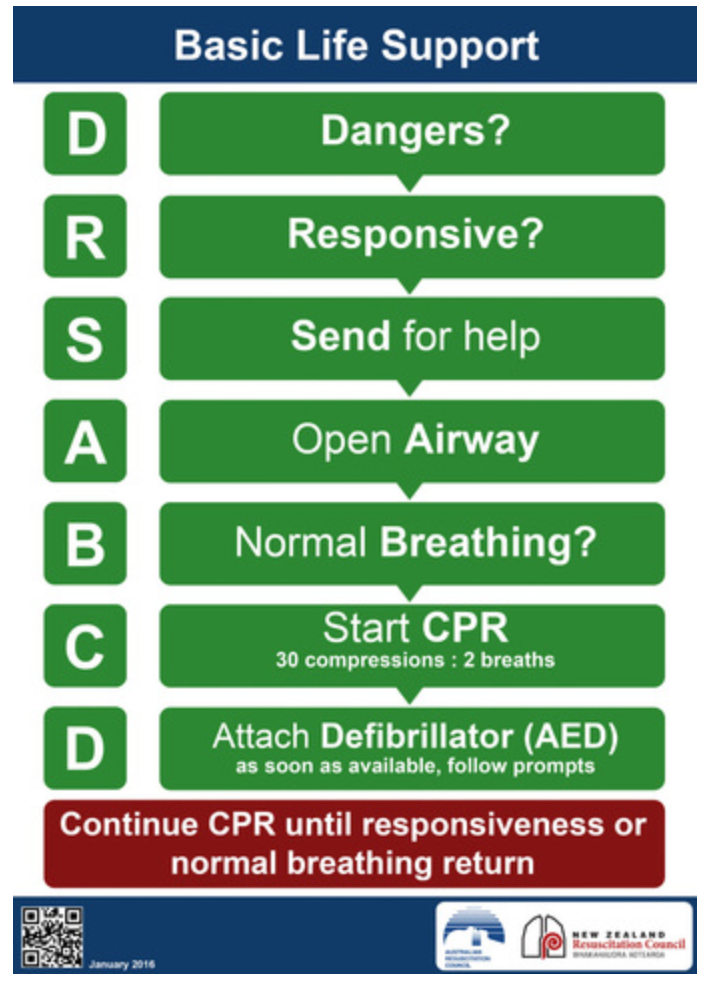
- In an unresponsive patient with no signs of life (i.e. no pulse) commence CPR and call the MET
- In an unresponsive patient with a pulse follow Acute Respiratory Failure or Unconsciousness
Airway
- Open and clear the airway and prevent aspiration
- Use airway positioning, suction, airway adjuncts
- See Acute Airway Failure
Breathing
- Assess work and efficacy of breathing including pulse oximetry
- Give oxygen and provide assisted ventilation if ventilatory failure present
- Aim for sats of 94-98% with oxygen in ACS
RATES
- Respiratory rate over 1 minute
- Auscultation
- Trachea position
- Effort
- Sats probe
Circulation
- Recheck vital signs
- Look for shock by assessing tissue perfusion and volume status
- Place ECG and NIBP monitoring
- Look for unstable arrhythmias or evidence of ACS
- Obtain IV access
- Take bloods when inserting the IVC
- Commence fluids and haemodynamic support if evidence of circulatory failure
- Give 20 mL/kg IV fluid rapidly if hypovolaemic shock
- Optimise abnormal cardiac rhythm with cardioversion, pacing or antiarrhythmic agent
Circulation Assessment
- ECG/Defibrillation pads
- BP
- IV access and bloods
- Capillary refill
- Other (JVP, drains, mucous membranes)
Disability
- Disability
- Dextrose
- Drugs
- Documentation
- Attach defibrillator
- Assess for depressed GCS
- GCS ≤8 indicates inadequate airway protection
- Note pupil size and lateralising signs
- See Acute neurological failure
Attach Defibrillator
- Remember safety considerations of attaching a defibrillator using DOOR:
- D: ensure patient is dry prior to applying pads
- O: Do not place pads over other objects (e.g. pacemakers, jewellery, clothes, ECG leads, medication patches)
- O: Oxygen to be away from patient prior to pressing the shock button
- R: Visually re-check and ensure no one is touching the patient prior to pressing the shock button. Ensure that you announce clearly to everyone that you are about to deliver a shock
- Optimum size for adults is 10–13 cm in diameter (smaller in children)
- Do not place over female breast (↑ impedence)
- Standard placement
- Right chest: 2nd intercostal space, mid-clavicular line
- Left chest: 5–6th intercostal space, mid-axillary line
- Anteroposterior placement
- Anterior chest: 5–6th intercostal space, anterior or mid-axillary line
- Posterior chest: over left or right infrascapular region
- Indications
- VF, pVT and asystole when fine VF cannot be confidently excluded
- Standard Usage (different to ALS):
- Observe ECG trace and identify rhythm
- Select energy level
- Charge. Once the defibrillator is charged, state loudly: ‘Stop CPR and move away.’ Visually confirm the shockable rhythm is still present
- Check that no personnel are in physical contact with the patient or bed and state loudly: ‘Delivering shock’
- Press ‘Shock’ on the defibrillator. Immediately state loudly ‘Recommence CPR’ without checking the rhythm or pulse.
Environment, exposure and examination
- Measure and normalise body temperature
- Investigations to perform in critically ill patients:
- Measure and normalise blood glucose
- VBG/ABG
- Urinalysis and monitoring of urine output
- ECG
- CXR
- Bloods:
- FBC, UEC, LFT, blood cultures, blood levels of a measurable drug
- Other investigations to consider:
- CT head, LP
- Consider antidotes such as naloxone, electrolyte replacement etc
- Perform full top-to-toe examination (undress the patient)
- Head and neck including ears, nose, teeth, oral cavity
- Chest
- Abdomen
- Perineum
- Back (may require a ‘log roll’)
- Limbs including peripheral circulation
- CNS including eyes and cranial nerves, limbs and higher cerebral functions
- Obtain history from any source
- Decide on a working diagnosis and definitive management plan
- Consider which level of care is required by the patient (e.g. ward level, HDU, CCU or ICU)
- Documentation