Classification
- Hypothermia is a core temperature <35°C
- By core temperature (ANZCOR, WMS thresholds):
- Mild (32–35°C): may be apathetic but not confused or drowsy, shivering
- Moderate (28–32°C): drowsy or confused, shivering reducing
- Severe (<28°C): usually unconscious, not shivering, may lack vital signs
- Some add a profound category below 24°C or below 20°C
- Revised Swiss System is used out of hospital when core temperature can’t be measured; stages are based on conscious state and estimate the risk of hypothermic cardiac arrest rather than core temperature
- Stage 1: alert (GCS 15), low risk
- Stage 2: responds to voice (GCS 9–14, includes confusion), moderate risk
- Stage 3: responds to pain or unresponsive (GCS <9) with vital signs present, high risk
- Stage 4: unresponsive with no detectable vital signs, i.e. hypothermic cardiac arrest
- Shivering no longer defines a stage, although a shivering patient usually has a core temperature >30°C
- A UK modification uses ACVPU, adding new confusion as a step between alert and verbal1
- Clinical signs and measured temperature often don’t match; if they don’t, consider concurrent pathology such as trauma, hypoglycaemia or intoxication
- Hypothermic cardiac arrest is unlikely above 30°C in young healthy patients but can occur below 32°C in older patients and those with comorbidities
- Vital signs can still be present below 24°C
Cloze
What core temperature defines hypothermia? <35°C
Cloze
What are the core temperature ranges for mild, moderate and severe hypothermia? Mild 32–35°C, moderate 28–32°C, severe <28°C
Aetiologies
- Primary hypothermia: cold exposure, including immersion (Drowning)
- Secondary hypothermia
- Impaired thermoregulation: stroke, traumatic brain injury, Parkinson’s disease, hypothalamic dysfunction, spinal cord transection, peripheral neuropathy, anorexia nervosa, drugs and toxins, general anaesthesia
- Decreased heat production: Hypoglycaemia, Hypothyroidism, hypoadrenalism, hypopituitarism, diabetic or alcoholic ketoacidosis, malnutrition, extremes of age, impaired shivering
- Increased heat loss: burns, skin disease, drug-induced vasodilation, cold infusions, Sepsis, trauma, shock
- Risk factors include homelessness, substance use, immobility, cognitive impairment, social isolation, infants and older age, and trauma
Cloze
What are common secondary causes of hypothermia? Sepsis, hypoglycaemia, hypothyroidism, intoxication (e.g. alcohol, sedatives), stroke or traumatic brain injury, burns
Clinical Features
- Mild: shivering, dysarthria, ataxia, apathy, tachypnoea, tachycardia, hypertension, cold diuresis; can still rewarm spontaneously once out of the cold
- Moderate: drowsiness or confusion (paradoxical undressing may occur), reduced shivering, increased muscle tone, bradycardia, slow AF or junctional rhythm, hypotension, respiratory depression
- Severe: coma, apnoea, fixed dilated pupils, loss of the ability to rewarm spontaneously (body temperature follows the environment), high risk of VF or asystole with movement
- “Umbles” of mild to moderate hypothermia: fumble, mumble, grumble, stumble
- Shivering usually stops somewhere between 32 and 28°C, or earlier once glycogen stores run out
- Fixed dilated pupils, apparent rigor mortis and livor mortis are unreliable signs of death
- ECG: sinus bradycardia, AF, junctional rhythms, J (Osborn) waves, prolonged PR and QT, broad QRS, ST and T wave changes, then VF and asystole
- Apart from VF, these usually resolve with rewarming
- J waves occur in most but not all patients and don’t correlate well with temperature
Cloze
What are the “umbles” of mild to moderate hypothermia? Fumble, mumble, grumble, stumble
Cloze
What ECG changes may be present in hypothermia? Sinus bradycardia, AF, junctional rhythms, J (Osborn) waves, prolonged PR and QT, broad QRS, then VF and asystole
Cloze
Which apparent signs of death are unreliable in hypothermia? Fixed dilated pupils, apparent rigor mortis and livor mortis
Assessment
- Handle gently and keep horizontal if moderate or severe, as movement can precipitate VF
- Check for a carotid pulse and breathing for up to 1 minute; ECG, Et and echo help confirm cardiac output
- Don’t start compressions if there is any breathing (even slow gasping), a pulse, or an organised perfusing rhythm, as compressions can convert it to VF
- Core temperature needs a low-reading thermometer
- Distal oesophageal probe if a tracheal tube or supraglottic airway is in place
- Epitympanic thermocouple if spontaneously breathing; standard infrared tympanic thermometers are not validated at low temperatures
- Rectal and bladder temperatures lag behind core temperature during rewarming
- Standard clinical thermometers may not read below about 34°C
Cloze
How should core temperature be measured in a patient with suspected severe hypothermia? Low-reading thermometer: distal oesophageal probe once the airway is secured, or an epitympanic thermocouple if spontaneously breathing
Cloze
Why should a patient with moderate or severe hypothermia be handled gently and kept horizontal? Movement can precipitate VF
Cloze
A cold, unresponsive patient appears lifeless. For how long should a pulse and breathing be checked before starting CPR? Up to 1 minute
Investigations
- Continuous ECG
- Glucose: can be high, normal or low; monitor for rebound hypoglycaemia during rewarming
- VBG: pH rises by about 0.015 per 1°C fall in temperature; interpret using alpha-stat (sample analysed at 37°C, uncorrected)
- UEC: hypokalaemia while cold and hyperkalaemia during rewarming, and concentrations can change quickly; hyperkalaemia in cardiac arrest suggests hypoxia preceded the hypothermia
- FBC (haemoconcentration, low platelets and white cells), coagulation studies (prolonged PT and APTT), CK for Rhabdomyolysis with urine myoglobin if raised, CXR
- Group and hold if there is trauma or bleeding risk
- Screen for secondary causes (e.g. sepsis, hypothyroidism, intoxication)
Management
Disposition
- Mild hypothermia may not need hospital if uninjured (including no localised cold injury) and GCS 15 after at least 30 minutes lying horizontal and rewarming
- Moderate or severe hypothermia needs hospital admission and possibly ICU; seek early advice about transfer to an ECMO centre
Rewarming
- Remove from the cold, remove wet clothing with minimal movement, insulate (multilayered wrap with a vapour barrier) and warm the environment
- Mild: passive external rewarming (insulation, allow shivering, warm sweet drinks if alert), adding active external rewarming if not responding
- Moderate or severe: active external rewarming, escalating to active internal rewarming if failing to rewarm
- Failure to rewarm: core temperature static or falling, rising lactate, falling GCS, falling BP, ventricular arrhythmia
- Target 1–2°C/hr for active rewarming to limit afterdrop (continued core cooling as cold, acidaemic peripheral blood returns to the core), which risks arrhythmias, hypotension and electrolyte shifts
- Active external rewarming
- Forced warm air or large heating pads to the axillae, chest, back and groin, checking the skin every 20–30 minutes
- Avoid small chemical heat packs (ineffective and burn) and warm baths or showers (risk of collapse)
- Defer warming the peripheries until core temperature is corrected in moderate or severe hypothermia
- Approximate rewarming rates
- Passive or active external: 0.5–4°C/hr
- Bladder lavage: <0.5°C/hr, not recommended; gastric lavage not recommended
- Intravascular catheter: about 0.5–2.5°C/hr; CRRT about 1.5–3°C/hr
- ECLS: about 4–10°C/hr
- Transfer directly to an ECLS centre if in cardiac arrest or at high risk of arrest: core temperature <30°C, ventricular arrhythmia or SBP <90 mmHg2
- If an ECLS centre can’t be reached (ERC suggests within 6 hours), start non-ECLS rewarming at the peripheral hospital
- With spontaneous circulation, aim for normothermia (about 37°C); after ROSC follow targeted temperature management
Cloze
What is the first-line rewarming method in mild hypothermia? Passive external rewarming (remove wet clothing, insulate, allow shivering)
Supportive Care
- Don’t delay intubation when indicated; it’s considered safe if done gently
- Aim for normocapnia when it can be monitored
- Reduce doses and lengthen intervals for anaesthetic and paralysing agents
- Fluids: 0.9% sodium chloride warmed to about 40–42°C3, given slowly as the patient rewarms and the intravascular space expands
- Use a fluid warmer; never heat fluids in a microwave
- Some hypotension is expected, so reassess frequently to avoid fluid overload
- Vasopressors are generally avoided in significant hypothermia and withheld below 30°C
- Arrhythmias other than VF, including AF and bradycardia, usually resolve with rewarming
- Treat hypoglycaemia; don’t give insulin early for hyperglycaemia
- CVVH can be used for hyperkalaemia or acidosis and also rewarms
Cloze
What IV fluid is preferred in hypothermia? 0.9% sodium chloride warmed to about 40–42°C
Hypothermic Cardiac Arrest
- CPR at normal compression and ventilation rates; consider mechanical CPR for prolonged resuscitation or transport
- If immediate CPR isn’t possible, delay it by no more than 10 minutes
- If continuous CPR isn’t possible below 28°C, alternate at least 5 minutes of CPR with no more than 5 minutes without (no more than 10 minutes below 20°C)
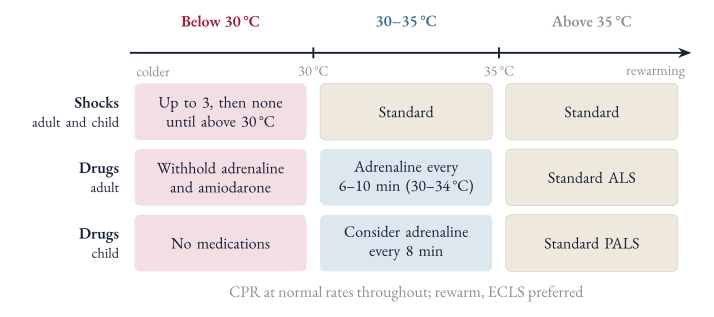
- Defibrillation: if VF persists after 3 shocks, delay further shocks until core temperature is >30°C4
- Adrenaline: withhold below 30°C; extend the interval to 6–10 minutes at 30–34°C5
- Amiodarone: don’t give below 30°C
- Rewarm with ECLS, VA-ECMO preferred over cardiopulmonary bypass; target ≤5°C/hr, and about 2°C/hr may give better neurological outcomes
- Not contraindications to rewarming: asystole, unwitnessed arrest, low core temperature, long no-flow or low-flow time, fixed dilated pupils, old age, trauma
- Withhold or stop: valid not-for-resuscitation order, obvious irreversible death, danger to rescuers; seek specialist advice before stopping if core temperature isn’t rising
- Good neurological outcomes are only expected if hypothermia preceded the arrest; ECPR isn’t recommended if core temperature is >30°C, there is major trauma or comorbidities preclude an acceptable recovery
Cloze
A patient in cardiac arrest has a core temperature of 27°C and is in VF. How are shocks and adrenaline modified? Up to 3 shocks, then no more until core temperature is above 30°C; withhold adrenaline until above 30°C, then give it every 6–10 minutes at 30–34°C
Cloze
What is the preferred rewarming method in hypothermic cardiac arrest? ECLS (VA-ECMO)
Paediatric Modifications
- Below 30°C: no medications, maximum of 3 shocks, then delay further shocks until >30°C
- 30–35°C: standard PALS, consider an adrenaline interval of 8 minutes
- Above 35°C: standard PALS
Avalanche
- ANZCOR: survival unlikely in cardiac arrest with an obstructed airway after burial >35 minutes, or with initial core temperature <32°C, or with initial K⁺ >12 mmol/L; otherwise full resuscitation including extracorporeal rewarming
- ERC/ICAR: withhold or stop if buried >60 minutes with asystole and a completely obstructed airway
Prognosis
- In-hospital mortality in moderate to severe hypothermia is almost 40%
- HOPE score estimates survival after ECLS rewarming from age, sex, mechanism (asphyxia or not), core temperature, K⁺ and CPR duration
- Recommended for in-hospital decisions about ECLS rewarming
- On external validation, a predicted survival <10% had a negative predictive value of 97%
- Outperformed K⁺ alone in its derivation
- K⁺ >12 mmol/L is the traditional threshold for withholding or stopping resuscitation (WMS, ICAR)
- Recovery after hours of hypothermic cardiac arrest is well documented
- Lowest reported core temperature with successful resuscitation after hypothermic circulatory arrest is 13.7°C
Sources
- ANZCOR Guideline 11.10 Resuscitation in Special Circumstances (July 2026) Accessed 10/11/2026
- ANZCOR Guideline 12.4 Paediatric Resuscitation in Special Circumstances (April 2026) Accessed 10/11/2026
- eTG: Accidental hypothermia (published May 2022, amended March 2023) Accessed 10/11/2026
- BMJ Best Practice: Accidental hypothermia (updated 06/08/2026) Accessed 10/11/2026
- LITFL: Hypothermia Accessed 10/11/2026
- Paal P et al. Accidental Hypothermia: 2021 Update. Int J Environ Res Public Health 2022;19(1):501 Accessed 10/11/2026 Found via Heidi Evidence
- Musi ME et al. Clinical staging of accidental hypothermia: the Revised Swiss System. Resuscitation 2021;162:182–7 Accessed 10/11/2026 Found via Heidi Evidence
- Gray D et al. A regional modification to the Revised Swiss System including confusion. Scand J Trauma Resusc Emerg Med 2024 Accessed 10/11/2026 Found via Heidi Evidence
- Pasquier M et al. The HOPE score. Resuscitation 2018;126:58–64 Accessed 10/11/2026 Found via Heidi Evidence
- Pasquier M et al. An external validation of the HOPE score. Resuscitation 2019;139:321–8 Accessed 10/11/2026 Found via Heidi Evidence
Footnotes
-
Gray 2024; UK-specific, not adopted by ANZCOR ↩
-
ERC 2025 also includes HR <45, and <32°C if frail with multiple comorbidities; eTG says ECMO may be needed below 28°C or with haemodynamic instability ↩
-
ERC says 38–42°C; WMS says at least 40°C, preferably 42°C ↩
-
eTG restricts defibrillation to one attempt below 30°C ↩
-
ERC 2025 uses 30–35°C; ANZCOR paediatric guidance suggests 8 minutes at 30–35°C ↩