- Compartment models describe the body as one or more well-mixed spaces the drug moves between, so that plasma concentrations over time can be described mathematically
- The compartments are mathematical rather than anatomical, although they loosely correspond to groups of tissues with similar blood flow
One-Compartment Model
- The drug distributes instantly and evenly through a single volume (), so after an IV bolus the only process is elimination:
- A plot of log concentration against time is a straight line with slope , and extrapolating it back to gives
Two-Compartment Model
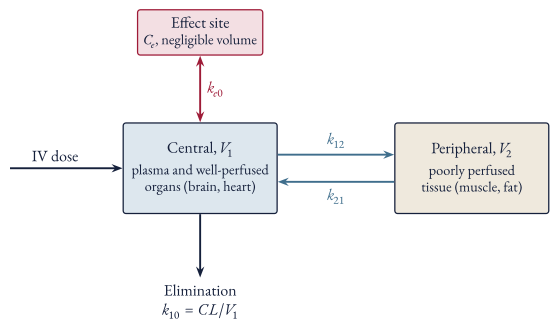
- The drug is given into a small central compartment (: plasma and well-perfused organs such as the brain, heart, liver and kidney) and distributes to a peripheral compartment (: poorly perfused tissue such as muscle and fat)
- Elimination is assumed to happen from the central compartment
- Elimination is assumed to happen from the central compartment
- Writing the amount of drug in each compartment as and :
- The solution after an IV bolus is the sum of two exponentials (biexponential):
- **Distribution phase ($\alpha$, fast):** plasma concentration falls steeply as drug moves out to the peripheral compartment, even though little has been eliminated yet
- **Elimination phase ($\beta$, slow):** once the compartments have equilibrated, plasma concentration falls at a rate set by clearance; the elimination (terminal) half-life is $0.693/\beta$
What equation describes plasma concentration after an IV bolus in a two-compartment model, and what does each phase represent?
. The fast phase is distribution from the central to the peripheral compartment; the slow phase is elimination after the compartments have equilibrated (terminal half-life ).
Volumes in a Two-Compartment Model
- With two compartments, “the” volume of distribution depends on when it is measured, since the ratio of amount in the body to plasma concentration changes as the drug distributes:
| Volume | Formula | Meaning |
|---|---|---|
| Central () | Volume at the moment of injection, before any distribution | |
| Steady state () | Amount in the body divided by plasma concentration at steady state | |
| Area ( or ) | Relates amount to concentration during the elimination phase | |
| Extrapolated () | What back-extrapolating the terminal phase gives |
- In order of size:
- Back-extrapolating the terminal phase to gives its intercept () rather than the true initial concentration (), which overestimates the volume:
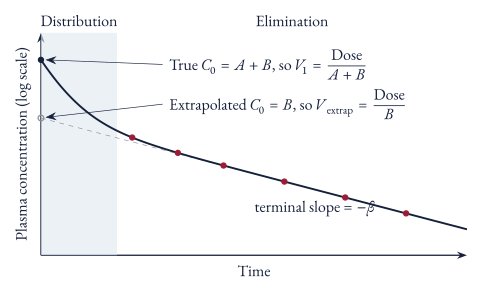
- How much it overestimates depends on how fast distribution is compared with elimination. Integrating the biexponential for the AUC:
- When distribution is much faster than elimination ($\alpha\gg\beta$), the $A\beta/\alpha$ term is negligible and $V_{\text{extrap}}\approx V_{\text{area}}$, which is why the one-compartment back-extrapolation is usually good enough
- When distribution is slow or large (e.g. digoxin), the extrapolated volume overestimates
- The central volume determines the peak concentration straight after a bolus (), whereas is the one to use for a loading dose
Why does back-extrapolating the terminal phase overestimate the volume of distribution in a two-compartment model?
It gives the intercept of the elimination phase () rather than the true initial concentration (), so is larger than . The error is small when .