Contraindications
- Absolute
- Right sided endocarditis
- Right sided masses (e.g. myxoma) or thrombi
- Relative
- Severe coagulopathy
- Severe thrombocytopaenia
- Reasons for caution
- Tricuspid regurgitation - difficult passage of catheter
- Left bundle branch block - catheter passage may induce complete heart block ⇒ be prepared to place a transvenous pacemaker should this occur
Method
Complications
- Pulmonary artery perforation
- Risk factors
- Older age
- Prolonged balloon inflation
- Pulmonary hypertension
- Anticoagulation
- Clinical features
- Haemoptysis
- Hypoxaemia
- Shock
- Management
- Inflate the balloon
- Intubate the patient with a dual-lumen endotracheal tube
- Lateral decubitus position with affected side down
- Emergency consultation with cardiothoracic surgeon and interventional radiology
Calculations
- Fick equation where:
- CO is the cardiac output (L) which is normally 4.8 - 7.3 L
- V˙OX2 is the oxygen consumption (mL/min)
- Ca is the oxygen content of arterial blood (mL/L)
- Cv is the oxygen content of venous blood (mL/L)
CO=Ca−CvV˙OX2=1.36×Hb×(SaOX2−SvOX2)×10V˙OX2
- Cardiac index equation where:
- CI is the cardiac index (L/min m^2) which is normally 2.8 - 4.2 L
- BSA is the body surface area (m^2)
CI=BSACO
- Systemic vascular resistance where:
- SVR is the systemic vascular resistance (dyn sec/cm^5) which is normally 700 - 1600
- MAP is the mean arterial pressure (mmHg)
- RA is the right atrial mean pressure (mmHg)
- CO is the cardiac output (L)
SVR=COMAP−RA×80
- Pulmonary vascular resistance where:
- PVR is the pulmonary vascular resistance (dyn sec/cm^5) which is normally 20 - 130
- PA is the pulmonary artery mean pressure (mmHg)
- PCWP is the pulmonary capillary wedge pressure (mmHg)
- CO is the cardiac output (L)
PVR=COPA−PCWP×80
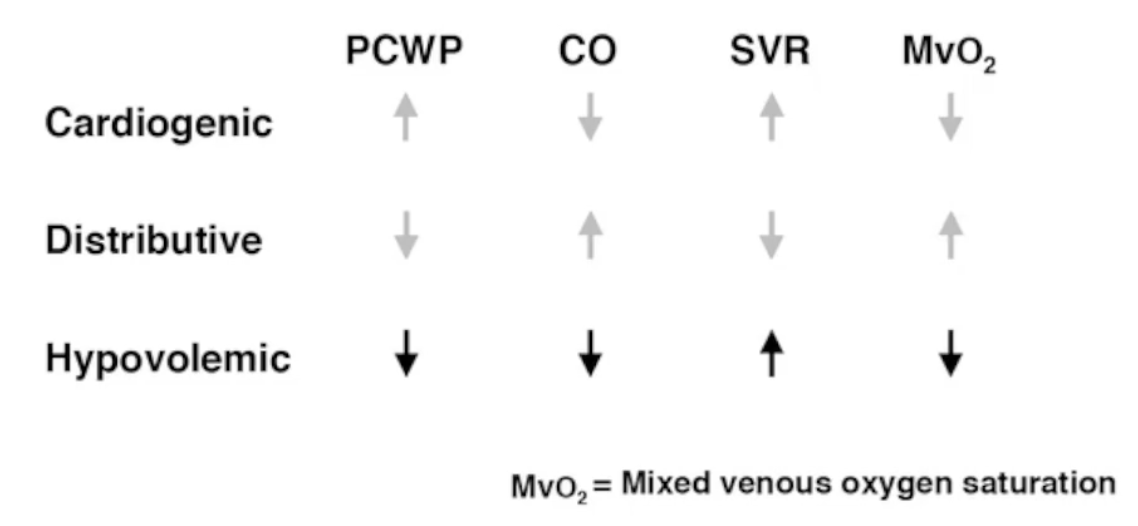
- The above calculations can differentiate the type of Shock:
Sources