- Move defibrillator pads to pacing position
- You often need
- If necessary, use clippers, scissors or a razor to quickly remove excess chest hair from the skin where the pads are applied
- Ensure that the skin is dry
- Use A-P positions for defibrillator pads if possible
- If movement artefact appears to be inhibiting the pacemaker, switch the device to deliver fixed-rate pacing
- Select an appropriate pacing rate (usually in the range of 60-90 beats/min). In some circumstances (e.g. complete AV block with an idioventricular rhythm 50 beats/min) a slower pacing rate of 40 or even 30 beats/min may be appropriate in order to deliver pacing only when required during sudden ventricular standstill or more extreme bradycardia
- Warn the patient
- Gradually increase the output while observing the patient and the ECG
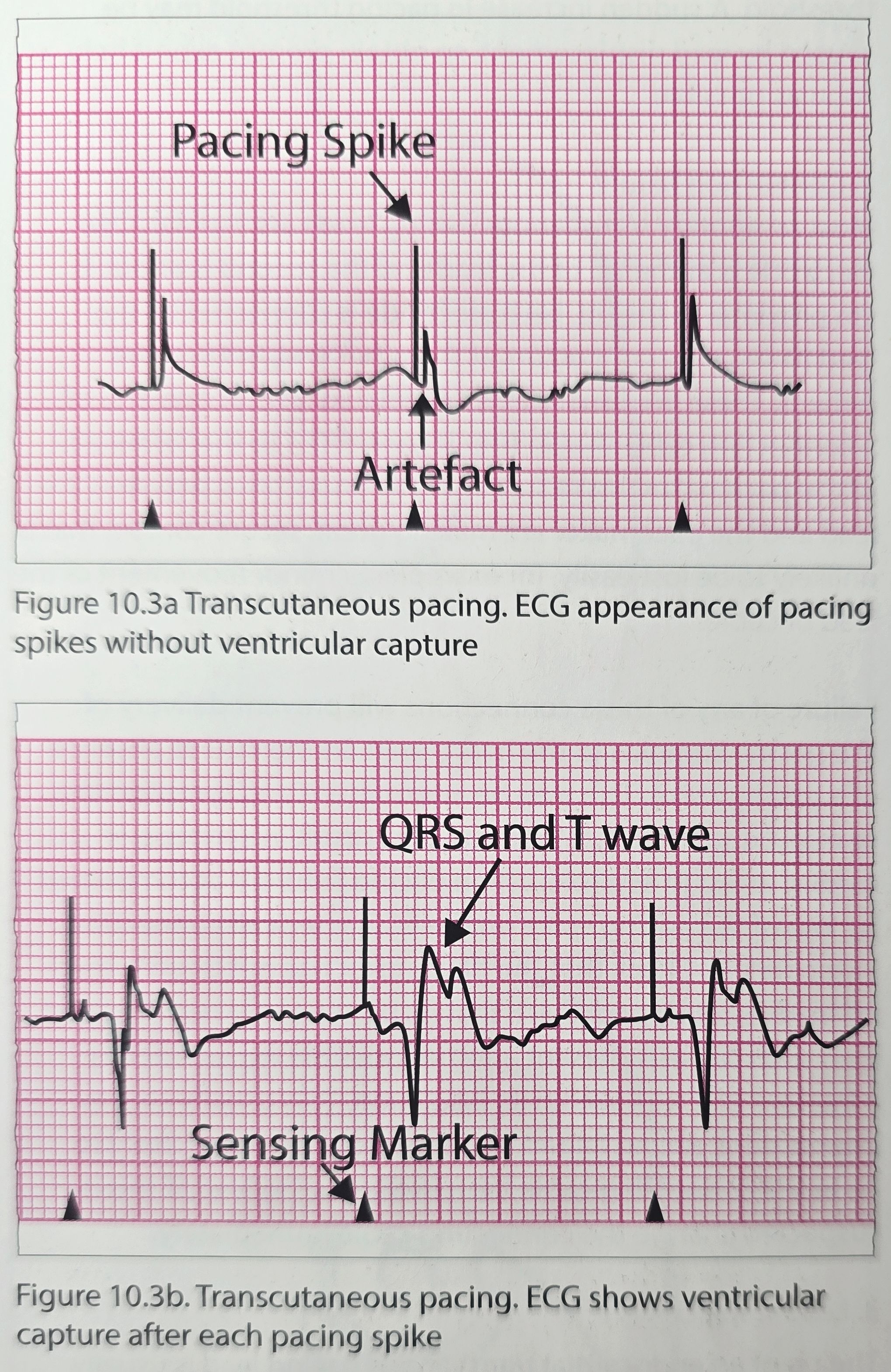
- As the current is increased the muscles of the chest wall will contract with each impulse and a pacing ‘spike’ will appear on the ECG
- Increase the current until each pacing spike is followed immediately by a QRS complex, indicating electrical capture (typically a current of 50-100 mA)
- In some circumstances when the need for pacing is urgent starting at the highest energy level and reducing until capture threshold is another method
- Check the apparent QRS complex is followed by a T wave
- Check that each paced QRS complex is followed by a palpable pulse (machanical response)
- Set the output to 10mA (10%) higher than the threshold to ensure maintenance of capture