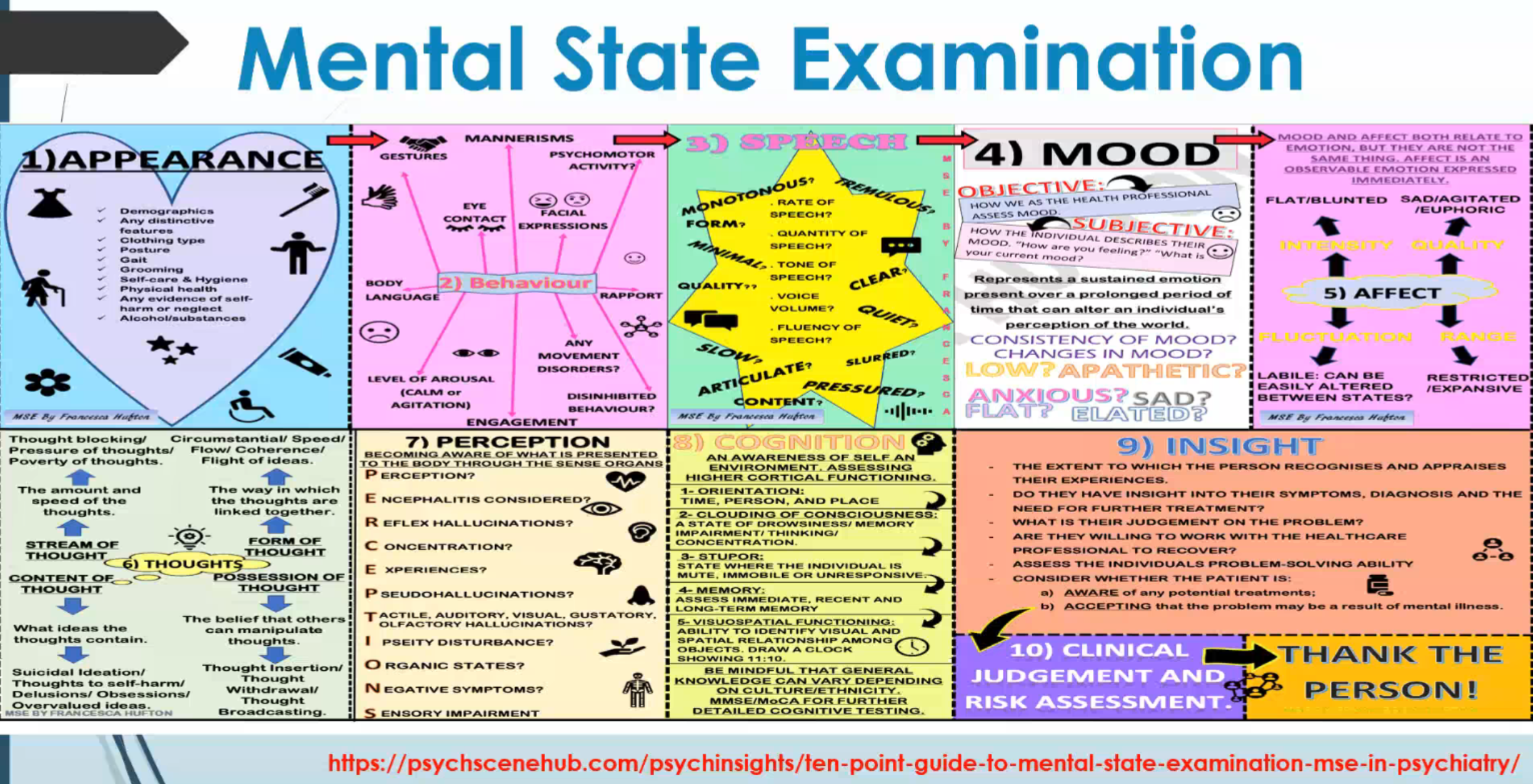
Appearance
- Consider: age, gender, race/ethnicity, build, hair style & colour, grooming, posture, level of hygiene, mode of dress, apparent level of health, signs of AOD use
EXAMPLE
Lisa is a 26 year old Caucasian woman, of slim build with long dark hair. She was dressed in crumpled jeans, which appeared dirty, and a T-shirt. She appeared to be in good health overall but with a poor level of personal care and grooming (which is unusual for Lisa who is known to the service).
Behaviour
- How does the patient behave?
- Consider: General behaviour, facial expression, eye contact, body movements and gestures
- How is the patient reacting to being in the session?
- i.e. co-operative, angry, hostile withdrawn, inappropraite, afraid, suspicious, evasive
EXAMPLE
Lisa was agitated and restless, moving in her chair and playing with her hair during the appointment. Her eye contact was intermittent. She was distracted in the session and at times she seemed to be responding to unseen stimuli (voices). Despite appearing to be unwell she communicated freely and was cooperative.
Speech and Language
- How is the patient talking (speech)?
- Rate - rapid, pressured, slow, retarded
- Volume - loud, whispered, quiet
- Tone - monotone, varied
- Quantity of information - poverty or pressure of speech, mute/silent
- How does the patient express himself/herself (language/form of thought)?
- Incoherent/illogical - disorganised or senseless speech
- Derailment - unrelated or loosely connected ideas
- Tangentiality or loosening of association - unrelated incomplete replies
- Absence or slowing of thought
- Thought blocking - thought flow is briefly interrupted or absent
Example
Lisa’s speech was of normal tone and rate.
Mood and Affect (Feelings)
- How does the patient describe his/her emotional state (mood)?
- What do you observe about the patient’s emotional state (affect)?
- Consider: depressed, anxious, angry, labile, inappropriate, high or elevated
- High mood:
- Cheerful
- Happy
- Jovial
- Euphoric
- Elated
- Ecstatic
Example
Lisa’s mood was not depressed or elevated but she appeared anxious, fearful and agitated.
Thought Content (Thinking)
- What is the patient thinking about? Consider the following:
- The amount of thought and its rate of production
- Continuity of ideas
- Disturbances of language
- Delusional thoughts
- Preoccupations
- Thoughts of harm to self or others
Example
Lisa’s speech flowed easily and she expressed herself clearly. She sometimes paused mid-sentence, appearing to be distracted by unseen stimuli, and at times had to be refocussed on the conversation. Lisa showed signs of paranoid and delusional thinking. She believed people were spying on her with cameras and microphones in her home. This is why she slept in the garden shed. She also thought her boyfriend had inserted a transmitter into her stomach while she was asleep. To her, this meant that her thoughts were being monitored. Lisa holds the belief that her boyfriend wants to harm her, so she is protecting herself by sleeping in the garden shed with a knife under her pillow. There is no history of domestic violence in the relationship nor does Lisa’s boyfriend have a history of harming others. While Lisa holds the belief that her boyfriend wants to harm her, there may be a risk of harm to him. Lisa has no previous history of self harm or harm to others.
Perception
- Consider the following:
- Hallucinations associated with any of the five senses (visual, olfactory, auditory, tactile, gustatory) also noting the degree of distress or fear associated with the particular hallucination
- Also note any command hallucinations where voices tell the person to do a particular thing
- Dissociative symptoms such as:
- Derealisation (external world seems strange or unreal)
- Depersonalisation (feels detached from their own thought processes or body)
- Illusions, where the person misinterprets sensory stimuli (e.g. hearing rustling leaves as voices)
- Hallucinations associated with any of the five senses (visual, olfactory, auditory, tactile, gustatory) also noting the degree of distress or fear associated with the particular hallucination
Example
Lisa was experiencing auditory hallucinations. She reported she was hearing different voices saying “horrible” things such as “you are no good”, “you are ugly”’ and that she needs to protect herself from her boyfriend. She was observed replying to what appeared to be voices during the appointment.
Cognition
- Consider:
- Level of consciousness
- Attention: can the patient stay focused during the appointment
- Memory: can the patient tell you what he/she did yesterday/last week
- Orientation
- Concentration:
- Abstract thinking
Example
Lisa had misplaced her medications and could not remember when she had last taken her tablets. She usually relies on her parents giving her the medication. Lisa also found it difficult to concentrate during the session. Otherwise she was alert and oriented to time and place.
Insight and Judgement
Example
Lisa showed insight and judgement. She was willing to consider that the experiences she was having could be due to a recurrence of her mental illness and was agreeable to the Mental Health Service being contacted for further assessment.
- Intellectual insight is when they are aware of the harm/benefit of something (e.g. they know that alcohol is hurting them)