Main source: Birkett, Pharmacokinetics Made Easy 1
- At steady state the dose rate going in equals the elimination rate coming out (see Clearance at Steady State), so for intravenous dosing:
- The unbound steady state concentration is , and it’s the unbound concentration which drives the effect
- The rest of this note is for a drug cleared by the liver, where only unbound drug is metabolised, so clearance follows the well-stirred model (see Hepatic Extraction Ratio (Well-Stirred Model)):
Determinants of Steady State Concentration
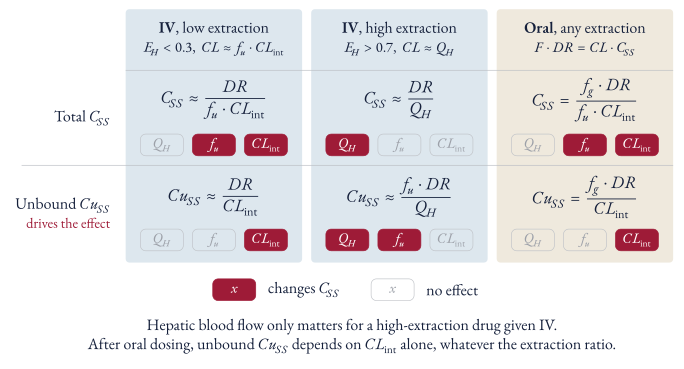
- For drugs given orally, the unbound concentration depends only on intrinsic clearance (and the fraction absorbed), and the total concentration depends on intrinsic clearance and fraction unbound, whatever the hepatic extraction ratio
- For drugs given intravenously, it depends on the hepatic extraction ratio:
- Low hepatic extraction ratio: the unbound concentration depends on intrinsic clearance, and the total concentration depends on intrinsic clearance and fraction unbound
- High hepatic extraction ratio: the unbound concentration depends on hepatic blood flow and fraction unbound, and the total concentration depends on hepatic blood flow
- Hence hepatic blood flow only matters for a high extraction ratio drug given intravenously
Intravenous Dosing
- For low hepatic extraction ratio drugs , so:
- For high hepatic extraction ratio drugs , so:
What determines the total and unbound steady state concentration of a low hepatic extraction ratio drug given IV?
, so (intrinsic clearance and fraction unbound) and (intrinsic clearance only)
What determines the total and unbound steady state concentration of a high hepatic extraction ratio drug given IV?
, so (hepatic blood flow only) and (hepatic blood flow and fraction unbound)
Oral Dosing
- Only the bioavailable fraction of each dose reaches the systemic circulation (see Bioavailability), so:
- Substituting the well-stirred model for both and :
- Hepatic blood flow drops out because it changes bioavailability and clearance by the same proportion, so a fall in blood flow lowers clearance but lets proportionally less drug through the liver on its first pass, and the two cancel
- This holds whatever the extraction ratio, as the approximations for low and high extraction drugs were never needed
Derive the unbound steady state concentration of a hepatically cleared drug given orally
with . Substituting and , the and terms cancel:
Cloze
After oral dosing of a hepatically cleared drug, the unbound steady state concentration depends only on intrinsic clearance, whatever the hepatic extraction ratio
Why doesn't hepatic blood flow affect the steady state concentration of a high extraction drug given orally?
A fall in hepatic blood flow lowers clearance () but also lowers the fraction escaping first-pass () by the same proportion, so , and hence , is unchanged
Clinical Consequences
- These follow from the figure above (Figure 1):
- Enzyme induction or inhibition (changing ) changes the unbound steady state concentration in every case except a high extraction ratio drug given intravenously
- Displacement from plasma proteins (raising ) lowers the total concentration but leaves the unbound concentration unchanged for low extraction ratio drugs and for oral dosing, so it’s mostly of no clinical consequence; the exception is a high extraction ratio drug given intravenously, where the unbound concentration rises
- A fall in hepatic blood flow (e.g. low cardiac output) only raises the steady state concentration of a high extraction ratio drug given intravenously, e.g. a lignocaine infusion
When does displacement of a drug from plasma proteins raise its unbound steady state concentration?
Only for a high hepatic extraction ratio drug given IV (). For low extraction drugs and oral dosing, clearance rises with , so the total concentration falls and the unbound concentration is unchanged
Which steady state concentrations change with a fall in hepatic blood flow?
Only those of a high hepatic extraction ratio drug given IV, as (e.g. lignocaine in low cardiac output states). Low extraction drugs and oral dosing are unaffected