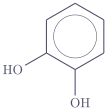
Catechol Ring
- A 6-carbon benzene ring with hydroxyl (–OH) groups at positions 3 and 4 (3,4-dihydroxybenzene)
- The two hydroxyl groups are critical for receptor affinity
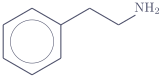
β-Phenylethylamine
- The backbone of all sympathomimetics: catecholamines, amphetamines, antidepressants, bronchodilators
- No hydroxyl groups → highly lipid soluble → crosses the BBB freely
- Has essentially no intrinsic pharmacological activity on its own — it’s purely a scaffold to hang functional groups on
Beta-Carbon
| Modification | Effect |
|---|---|
| –OH group added | ↓ lipid solubility → poor CNS penetration |
| Any substituent here | Greatly ↑ α and β receptor agonist activity |
Alpha-Carbon
| Modification | Effect |
|---|---|
| Any substituent here | Blocks MAO → ↑ half-life |
| Drug lingers longer at synapse → indirect sympathomimetic effect |
Amine tail group
| Amine substituent | Receptor preference | Example |
|---|---|---|
| None (–NH₂) | α-selective | Noradrenaline |
| Short alkyl (–CH₃) | Balanced α + β | Adrenaline |
| Longer alkyl | β-selective | Isoprenaline, salbutamol |
- Bigger alkyl substituent on the amine = more β-receptor preference
Aromatic Ring Hydroxyl Groups
| Pattern | Effect |
|---|---|
| Two –OH groups (positions 3,4) | Maximum receptor affinity, but ↓ lipid solubility → excluded from CNS |
| No –OH groups | Good CNS penetration (e.g. phenylethylamine, amphetamine) |
| –OH at positions 3,5 (with large amine group) | β₂ selectivity |
| The catechol 3,4-hydroxyl pattern = maximum receptor binding, minimum CNS entry |
Clinical Correlates
See: Pressors
| Drug | Key structural feature | Consequence |
|---|---|---|
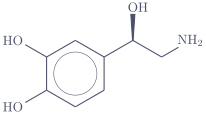
| Noradrenaline | No amine substituent | Potent α agonist |
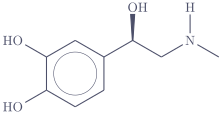
| Adrenaline | N-methyl group | Mixed α + β agonist |
| Salbutamol | Large N-alkyl + 3,5-OH pattern | β₂ selective, no CNS effect |
| Amphetamine | α-methyl group, no ring –OH | MAO resistant, CNS penetrant, indirect |
| Ephedrine | α-methyl + N-methyl | Indirect + direct, CNS penetrant |
 | ||
 |
Summary
- β-carbon OH → blocked from brain, boosted at receptors
- α-carbon substituent → avoids MAO, acts indirectly
- Bigger amine tail → more β, less α
- Two ring –OHs (3,4) → high affinity, but lipophobic; move to 3,5 → β₂ selectivity