Indications
- Arrest after cardiac surgery via median sternotomy ⇒ follow CALS instead of the standard ALS algorithm
- Emergency resternotomy is part of the arrest management within 10 days of the last operation; after day 10 it’s a senior clinician’s decision
- Most arrests happen early, within 24 hours of surgery (up to half within the first 3 hours of ICU admission), and survival is much better than for arrests elsewhere (around 80%)
- Usually the arrest is preceded by deterioration, but it can happen in a previously stable patient
Within how many days of cardiac surgery is emergency resternotomy part of CALS arrest management?
Within 10 days of the last operation; after day 10 it’s a senior clinician’s decision
Why CALS is Different
- The common causes are surgical (tamponade, haemorrhage) or electrical (VF, pacing failure), so they are usually reversible by defibrillation, pacing or reopening the chest
- External compressions are likely ineffective with tamponade, tension pneumothorax or massive haemorrhage, hence the emphasis on rapid resternotomy
- Prolonged external compressions can also damage thoracic structures early after surgery (e.g. grafts, valves)
- Internal massage is generally more effective than external compressions
- Full-dose adrenaline risks a hypertensive crisis and graft disruption once sinus rhythm returns, so only small doses are used (see Medicines)
Why does CALS prioritise early resternotomy over prolonged external compressions?
- The common causes (tamponade, haemorrhage, tension pneumothorax) make external compressions ineffective
- External compressions can damage thoracic structures early after surgery
- Internal massage is more effective than external compressions
Team Roles
- Six key roles, each allocated to a trained team member and rehearsed regularly:
- Team leader: runs the protocol and makes sure every role is filled
- ICU coordinator: a senior ICU clinician who prepares for resternotomy as soon as the arrest is called, manages the extra staff and calls for expert help
- Resternotomy team: generally two staff
- Resternotomy trolley
- Defibrillation and pacing
- Airway and breathing
- CALS-ANZ has no dedicated drugs role, which is different to the UK CALS protocol (via LITFL) where the six roles are external cardiac massage, airway and breathing, defibrillation, team leader, drug administration and ICU coordinator
- The UK drugs role stops all infusions and syringe drivers and gives amiodarone and anything else needed; in CALS-ANZ pausing and checking infusions is still a step, but it isn’t assigned to a named role
What are the six key roles in a CALS arrest (CALS-ANZ)?
- Team leader
- ICU coordinator
- Resternotomy team (two staff)
- Resternotomy trolley
- Defibrillation and pacing
- Airway and breathing
Initial Response
- Confirm arrest and assess the rhythm
- Check the arterial waveform and central pulse where available
- Call for help (cardiothoracic surgeon, intensivist, theatre) and prepare for emergency resternotomy in parallel with resuscitation
- Assess the airway and ventilation ⇒ manually ventilate the intubated patient
- FiO₂ 1.0 and turn PEEP off
- Exclude ETT problems, pneumothorax and haemothorax
- If not intubated, ventilate with BVM or a supraglottic airway; intubation is best done once the chest is open or after ROSC
- Pause all infusions and syringe drivers and check them for errors before restarting them one at a time
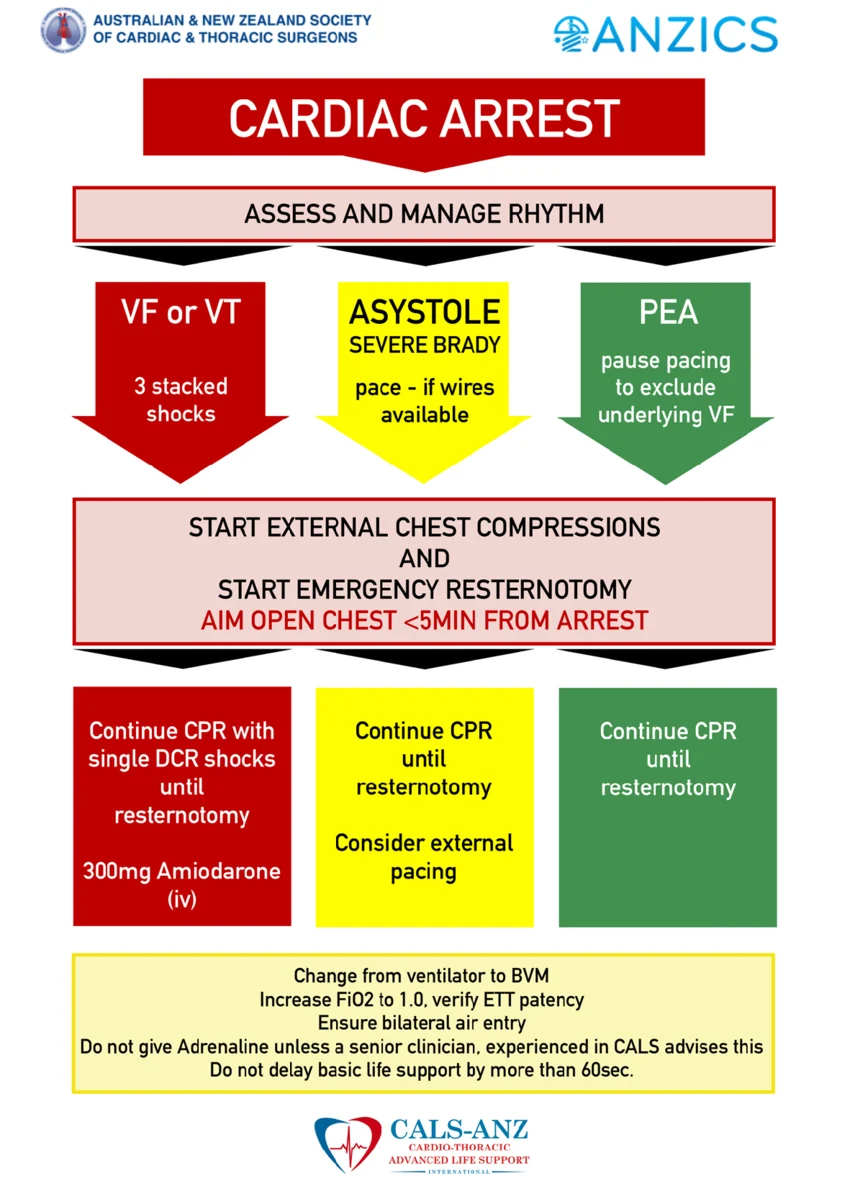
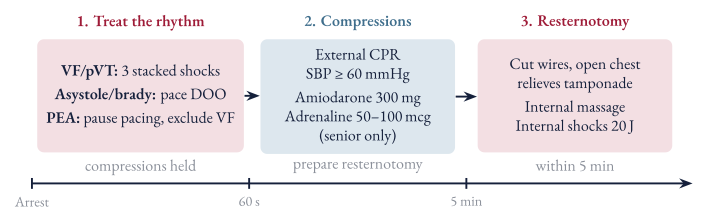
- External compressions can be withheld for up to 60 seconds while delivering rapid rhythm-specific treatment:
| Arrest Rhythm | CALS Response |
|---|---|
| Ventricular fibrillation or pulseless ventricular tachycardia | Up to three stacked shocks (200 J, 300 J, 320 J biphasic) Start compressions if no ROSC within 10 s of the third shock Amiodarone 300 mg after the third failed shock1 |
| Asystole or severe bradycardia | If epicardial pacing wires are present, pace in DOO mode2 |
| Pulseless electrical activity | If paced, briefly pause the pacemaker to exclude underlying ventricular fibrillation |
- Commence compressions while waiting for emergency resternotomy
- Don’t withhold compressions while setting up for resternotomy
- Aim for a systolic of at least 60 mmHg on the arterial trace
Cloze
In CALS, external compressions can be withheld for up to 60 seconds while the rhythm is treated, and the chest should be reopened within 5 minutes of the arrest
What is the CALS response to VF or pulseless VT?
- Up to three stacked shocks
- Start compressions if no ROSC within 10 s of the third shock
- Amiodarone 300 mg after the third failed shock
- Resternotomy if this fails
What is the CALS response to asystole or severe bradycardia with epicardial wires in place?
Pace in DOO mode
What should you do first in a CALS arrest with PEA in a paced patient?
Briefly pause the pacemaker to exclude underlying VF
What are the initial airway and ventilation steps in a CALS arrest?
- Manually ventilate with FiO₂ 1.0 and PEEP off
- Exclude ETT problems, pneumothorax and haemothorax
- If not intubated, BVM or supraglottic airway; intubate once the chest is open or after ROSC
Emergency Resternotomy
- Should be completed by a trained team within 5 minutes of the onset of the arrest
- Indicated if initial measures fail to restore ROSC, even if a surgical cause seems unlikely
- Steps:
- Cut through the dressing and adhesive drape down to the sternal wires
- Cut the wires and remove them ⇒ this alone may relieve a tamponade
- Place the retractor just beneath the sternum, suction clot and identify where the grafts are
- Internal massage: two-handed technique
- Right hand flat over the apex and behind the heart (palm up), left hand flat on the anterior surface, then squeeze at 100/min with palms flat and fingers straight
- Aim for a systolic of more than 60 mmHg on the arterial trace
- After mitral valve surgery, don’t lift the apex with the right hand, since this risks posterior ventricular rupture
- Internal defibrillation: 20 J, 30 J and 50 J with the internal paddles3
- 5 J if on bypass
What energy is used for internal defibrillation after resternotomy?
20 J (5 J if on bypass)
Why should you avoid lifting the apex during internal massage after mitral valve surgery?
It risks posterior ventricular rupture
Medicines
- Adrenaline to only be given under the direction of a clinician experienced in CALS and only in small doses (e.g. 50–100 mcg IV)
- Full doses risk a hypertensive crisis and graft disruption once sinus rhythm returns, and adrenaline hasn’t been shown to improve outcomes after post-cardiac surgery arrest
- Amiodarone 300 mg for refractory shockable rhythms after the three stacked shocks, but don’t delay resternotomy for it
Cloze
In CALS, adrenaline is only given under the direction of an experienced clinician, in small doses of 50–100 mcg IV
Reversible Causes
- Specific to post-cardiac surgery:
- Tamponade
- Haemorrhage and hypovolaemia
- Myocardial ischaemia (e.g. graft failure)
- Tension pneumothorax and haemothorax
- ETT problems
- Pacing failure
What are the reversible causes of arrest specific to post-cardiac surgery patients?
Tamponade, haemorrhage/hypovolaemia, myocardial ischaemia, tension pneumothorax, haemothorax, ETT problems and pacing failure
Sources
- CALS - YouTube
- Demonstration video: Wellington ICU Cardiac Advanced Life Support Emergency Resternotomy - YouTube
- The Australasian ANZSCTS/ANZICS guidelines on cardiothoracic advanced life support (CALS-ANZ)
- Cardiac Arrest Management After Cardiac Surgery • LITFL • CCC
- Guideline 11.10 Resuscitation in Special Circumstances
Footnotes
-
Each stacked shock is less likely to work than the one before (about 78%, 35% then 14%), so a fourth shock without intervening CPR isn’t recommended ↩
-
The UK CALS protocol (via LITFL) instead uses DDD at maximum atrial and ventricular output and a rate of 100/min ↩
-
CALS-ANZ only gives 20 J for internal defibrillation ↩