Assessment
While Standing
- Inspect the spine for any developmental or traumatic deformities.
- Assess the lumbar lordosis; loss of curvature may indicate ankylosing spondylitis.
- Look for any muscle wasting (buttock, thigh, calf).
- Check for any discrepancy in leg length by comparing the levels of the iliac crests.
- Movement:
- Ask the patient to extend the spine, flex forward and then flex laterally by sliding their palm down their outer thigh
- Most patients with non-specific back pain will be slightly stiff in extension, have pain on flexion, and asymmetric limitation and pain on lateral flexion.
While Lying Supine
- Rule out other joint involvement: check the hip joints for range of movement and pain
- Perform stress test on sacro-iliac joints (e.g. FABER test), especially in young patients
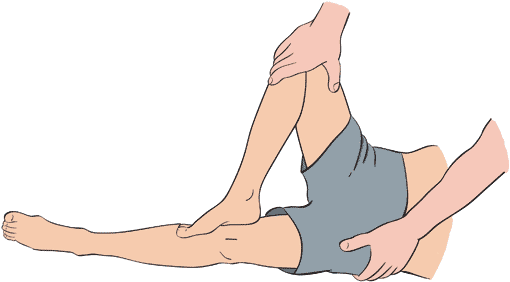
- Flexion, Abduction, and External Rotation (FABER):
- The patient lies in a supine position, and the foot is placed on the opposite knee; in this position groin pain indicates a hip problem rather than a spinal problem
- The doctor then presses on the flexed knee and on the opposite anterior superior iliac crest; pain in the sacroiliac area indicates a problem with sacroiliac joints
- Test nerve roots:
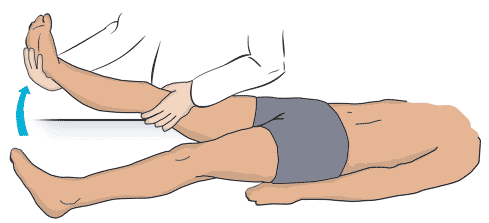
- Straight leg raise test
- This stretches nerve roots L4, L5 and S1
- Pick the leg up by the ankle
- While keeping the knee fully extended, lift the leg up towards ninety degrees
- If the patient has significant nerve root entrapment shooting leg pain will be reproduced before you get much beyond thirty degrees of elevation
- Back pain produced by straight leg raising is common and does not always indicate nerve root involvement.
- Straight leg raise test
- Assess muscle power
| Muscle group | Nerve Root |
|---|---|
| Resisted flexion of hip | L2/3 |
| Resisted knee flexion | S2 |
| Resisted dorsiflexion of ankle | L4 |
| Resisted extension of big toe | L5 |
| Resisted plantar flexion of ankle | S1 |
- Check reflexes:
- Knee jerk: L3/4
- Ankle jerk: L5/S1
- Plantar reflex: observe for up-going plantars
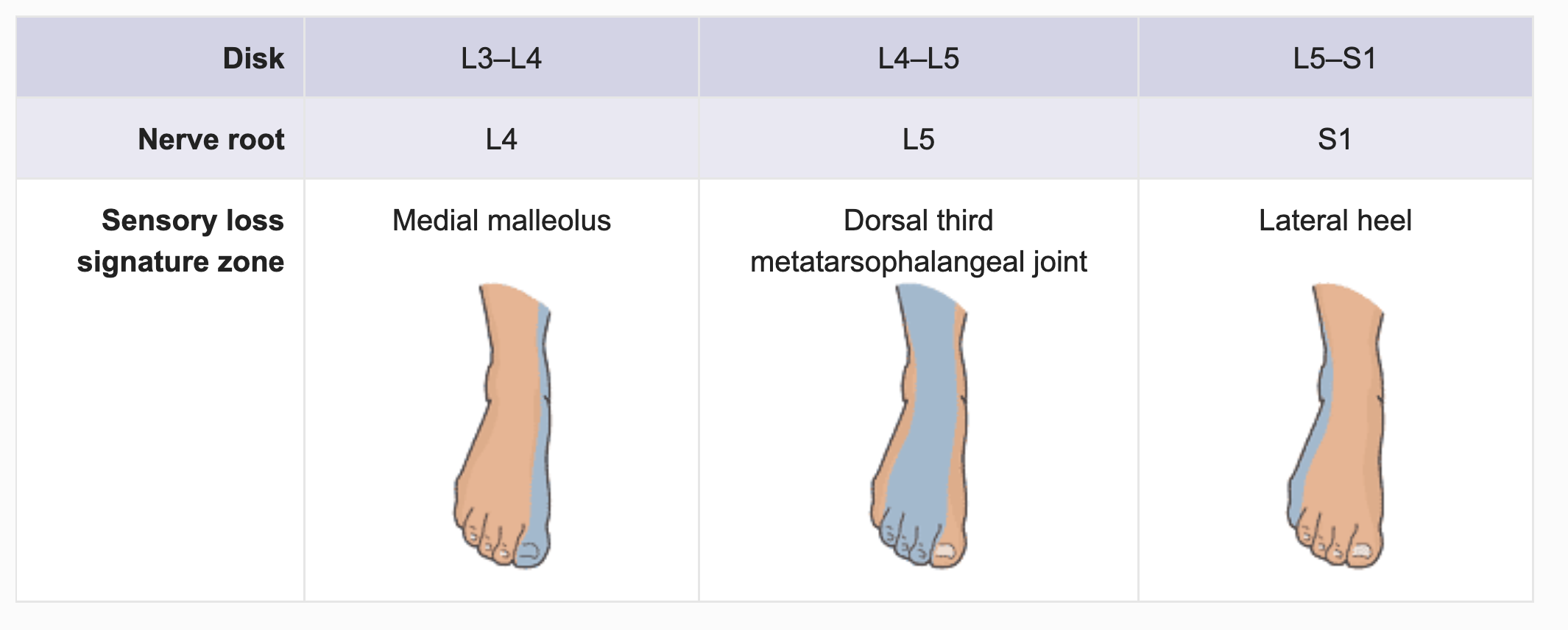
- Check for skin sensory loss
While Lying Prone
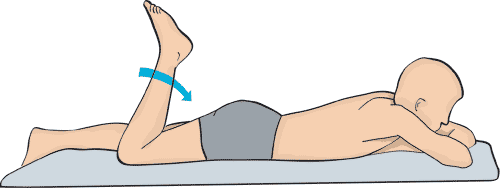
- Femoral stretch test (nerve roots L2/3/4)
- With the patient lying prone, flex the knee towards ninety degrees
- Burning discomfort in the groin or anterior thigh will occur if there is femoral nerve involvement
- Palpate the spine for tenderness and for muscle spasm
While on Side
- For patients who describe loss of sphincter control test for impaired sensation in the saddle area and assess anal sphincter tone with DRE